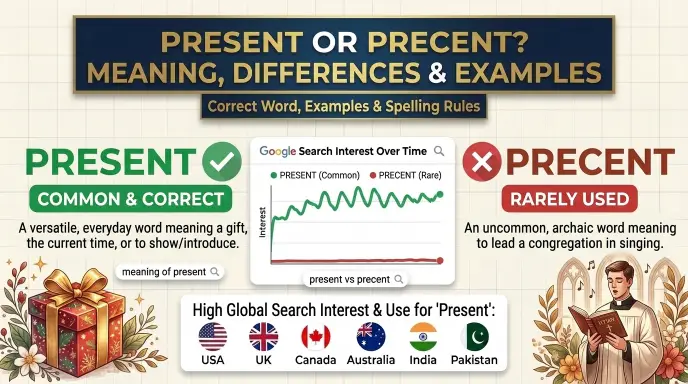
Have you ever typed present or present and wondered which spelling is right? You are not alone.
Many people make this mistake when writing emails, schoolwork, reports, and daily messages.
Both words look almost the same. However, only one is a standard English word.
The correct spelling is present. It can mean a gift, something happening now, or being in a certain place. It can also mean to show, give, or introduce something to others.
The word present is not a standard English word in everyday writing. This makes the choice much easier once you know the rule.
People often search for present or present because both spellings sound similar. A small spelling mistake can change how clear your writing looks. It may also make your work seem less professional.
In this guide, you will learn the correct spelling, meaning, origin, and use of present.
You will also see simple examples, common mistakes, and useful writing tips. By the end, you will know which word to use with confidence.
Present or Present :Quick Answer
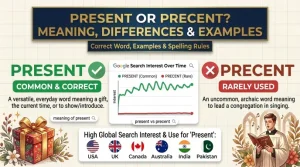
Present is the correct spelling in standard English. Percent is not a standard spelling of this word.
Use present when you mean a gift, the current time, or showing something.
Examples:
- She gave me a birthday present.
- All students are present today.
- I will present my ideas tomorrow.
- We must live in the present.
Incorrect: She bought me a beautiful present.
Correct: She bought me a beautiful present.
Remember this simple rule: Present is correct; present is incorrect when you mean a gift, current time, or showing something.
The Origin of Present or Present
The word present has a long history. It comes from the Old French word present. This word came from the Latin word praesens.
The Latin word praesens means being here or being in front of someone. Over time, the word developed several meanings in English.
It became useful in different situations. People began using it to describe something happening now. They also used it for gifts and formal acts of giving or showing something.
Today, present has several common uses:
- Present (noun): A gift given to someone.
- Present (adjective): Being somewhere or existing now.
- Present (verb): To show, give, or introduce something.
The spelling precedent does not come from a standard spelling change of present. It is usually a typing mistake or a spelling error.
Why do people confuse these words?
The letters in present and present look very similar. Their sounds can also cause confusion for English learners. However, only present is correct for the meanings discussed in this guide.
British English vs American English Spelling
British and American English sometimes use different spellings. Words like colour and color show this difference. However, present follows the same spelling in both forms of English.
There is no British or American spelling difference between present and present.
British English
People in the United Kingdom write present. They use it for gifts, current situations, and formal presentations.
Examples:
- Thank you for the lovely present.
- All members are present at the meeting.
- She will present the report tomorrow.
American English
People in the United States also write presents. The spelling and main meanings remain the same.
Examples:
- I bought a present for my mother.
- Everyone is present in class.
- He will present his research next week.
British vs American Spelling Comparison
| Feature | British English | American English |
| Correct spelling | Present | Present |
| Incorrect form | Precent | Precent |
| Gift meaning | Present | Present |
| Current time | Present | Present |
| Verb meaning | Present | Present |
| Pronunciation | Similar | Similar |
Key point: Both British and American English use present tense. The spelling does not change between these regions.
Which Spelling Should You Use?
The correct choice is always present when you mean a gift, current time, or showing something.
Your audience does not change this spelling. British, American, Canadian, Australian, and other English users write it the same way.
Here is some simple advice:
1. For American English
Use present in schoolwork, emails, business reports, and daily writing.
Example: I bought a special present for my friend.
2. For British English
Use present in formal and informal writing.
Example: She received a lovely present on her birthday.
3. For Commonwealth English
Countries like Canada, Australia, and New Zealand also use present.
Example: All team members were present at the event.
4. For Global English
Use present when writing for an international audience. It is clear and widely understood.
Professional advice: Never use present as a replacement for present. It is not an accepted spelling in standard English.
Common Mistakes with Present or Present
Many writers make small spelling mistakes when using present. These errors often happen because the words look and sound alike.
Here are some common mistakes and their corrections.
1. Writing Present Instead of Present
This is the most common mistake.
- Incorrect: I bought a present for my sister.
- Correct: I bought a present for my sister.
2. Using Percent in Formal Writing
Some people type present in reports, letters, or school assignments.
- Incorrect: Please accept this percentage from our team.
- Correct: Please accept this present from our team.
3. Confusing Present with Percent
The words present and percent look similar. However, they have different meanings.
- Present: A gift or something happening now.
- Percent: A part of 100.
Example: The present price is 20 percent lower.
4. Using the Wrong Word in a Sentence
Always check the meaning before choosing a word.
- Incorrect: All students are present today.
- Correct: All students are present today.
5. Forgetting the Correct Letter Order
The correct spelling is P-R-E-S-E-N-T.
A simple way to remember it is to focus on the middle letters: PRE-SENT.
Quick tip: Use a spell checker when writing important documents. It can help catch simple typing mistakes.
Present or Present in Everyday Examples
The word present appears in many types of writing. You can use it in emails, news reports, social media posts, and formal documents.
Here are some natural examples.
1. Present in Emails
Emails often use presents when discussing gifts, meetings, or current situations.
Examples:
- Thank you for the wonderful birthday present.
- All team members were present at the meeting.
- I will present the final report tomorrow.
2. Present in News
News writers use presents to discuss current events and public appearances.
Examples:
- The minister was present at the public event.
- The company will present its new plan today.
- Officials discussed the present economic situation.
3. Present on Social Media
People use presents in captions, posts, and personal messages.
Examples:
- Feeling happy with my birthday present!
- Enjoy the present and make every day count.
- Thank you for this beautiful present!
4. Present in Formal Writing
Present is common in academic and professional documents.
Examples:
- The research will present new findings.
- All participants must be present during the session.
- This report explains the present condition of the market.
Everyday Usage Comparison
| Situation | Correct example |
| Birthday | Thank you for the present. |
| School | All students are present. |
| Business | We will present the results. |
| News | The present situation remains difficult. |
| Social media | Enjoy the present moment. |
| Formal writing | The report will present the findings. |
Remember: Present works in many situations. Percent is not the correct replacement in any of these examples.
Present or Present :Google Trends & Usage Data
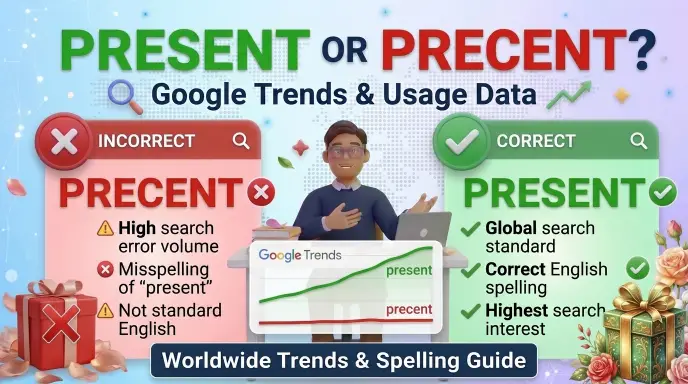
People search for present or present when they are unsure about the correct spelling. This confusion is common among English learners and people who write quickly.
However, there is an important difference between search interest and correct word usage.
Which Spelling Is More Popular?
Present is the established English spelling. It appears in dictionaries, books, news articles, educational content, and professional documents.
Precent is generally a spelling mistake when users intend to write present.
Usage by Country
| Country | Standard spelling | Common contexts |
| United States | Present | School, work, gifts |
| United Kingdom | Present | Daily and formal writing |
| Canada | Present | Education and business |
| Australia | Present | Emails and daily writing |
| Pakistan | Present | English learning and education |
| India | Present | School and professional writing |
Why Do People Search for These Words?
There are several reasons:
- Similar spelling: Both forms look almost identical.
- Typing errors: People sometimes press the wrong letters.
- English learning: Beginners may not know the correct form.
- Pronunciation: Similar sounds can cause spelling confusion.
- Writing mistakes: Users want to check their spelling before publishing.
What Does Google Trends Show?
Google Trends can help compare search interest for different terms. However, search interest does not prove that a spelling is correct.
No verified numerical country-by-country Trends figures are included here. Therefore, it would be misleading to claim exact search percentages or rankings.
For a useful comparison, check Google Trends and compare both terms using the same time range and country settings.
Final finding: Present is the accepted spelling. Present is generally an error, not a British or American spelling variation.
Present vs Present :Side-by-Side Comparison
The following table makes the difference easy to understand.
| Feature | Present | Precent |
| Correct spelling | Yes | No |
| Dictionary word | Yes | Not as a standard alternative |
| Meaning | Gift, current time, show | No intended standard meaning here |
| Part of speech | Noun, adjective, verb | Not a standard form |
| British English | Correct | Incorrect |
| American English | Correct | Incorrect |
| Formal writing | Accepted | Avoid |
| Everyday use | Common | Usually a typo |
Easy rule: If you mean a gift, something happening now, or showing something, always write a present.
Frequently Asked Questions
1. Is it present or present?
Present is the correct spelling. Present is not a standard spelling when referring to a gift, current time, or showing something.
2. What does present mean?
Present has several meanings. It can mean a gift, being somewhere, or something happening now. It can also mean to show or introduce something.
3. Is present a real English word?
Percent is not a standard English word for the meanings of present. It is usually a spelling mistake.
4. Is present correct in British English?
Yes, present is correct in British English. British writers use the same spelling as American writers.
5. Is present correct in American English?
Yes, present is also correct in American English. There is no spelling difference between the two varieties.
6. Why do people spell present as present?
People may confuse the letter order or type the wrong letters. Similar pronunciation can also cause spelling mistakes.
7. What is the difference between present and percent?
Present can mean a gift or the current time. Percent means a part of 100.
Example: My present cost 20 percent less than expected.
Conclusion
Choosing between present or present is simple once you understand the correct spelling. Present is the only standard spelling for a gift, the current time, or the act of showing something.
The word present is not an accepted alternative in standard English.
Both British and American English use present tense. The spelling stays the same in the United States, United Kingdom, Canada, Australia, and other English-speaking countries. You do not need to learn separate spelling rules for these regions.
Remember that present can work as a noun, adjective, or verb. You can give someone a present, be present at a meeting, or present an important idea.
Each use has a different meaning, but the spelling remains unchanged.
If you are writing emails, school assignments, reports, or social media posts, always choose a present. Check your spelling before sharing important work.
This small habit can improve your writing and help you avoid common mistakes.The final rule is easy: Present is correct, while precent is incorrect for these meanings.
Discover More Articles!
Ballon or Balloon: Which Is Correct? Meaning and Examples(20260
Cheak or Cheek: Which Is Correct? Meaning and Examples(2026)

I’m Michaelswal, an English grammar enthusiast passionate about helping people improve their writing and communication skills. I share simple, clear, and practical grammar tips to make learning English easier and more enjoyable.

1 thought on “Present or Precent: Correct Word, Examples, and Spelling Rules”