Have you ever wondered whether to write habit or habit? You are not alone. Many people make this spelling mistake when writing about daily actions, routines, and personal behavior.
Both forms look similar, but only one is correct in standard English.
The correct spelling is habit. The word habit means something you do often or regularly. It can be a good action, such as reading every day, or a bad action, such as biting your nails.
The spelling habit is incorrect and does not have a recognized meaning in standard English.
People often search for habit or habit because the word sounds like it may need two letters “b.” This confusion can happen when learning English or writing quickly.
A small spelling error can make your emails, schoolwork, and website content look less professional.
In this guide, you will learn the correct spelling, meaning, origin, and usage of habit. You will also find simple examples, spelling rules, common mistakes, and answers to frequently asked questions.
Habit or Habit :Quick Answer
Habit is the correct spelling. Habit is a common spelling mistake and is incorrect in standard English.
A habit is something you do often. You may do it every day without thinking much about it.
Examples:
- Reading before bed is a good habit.
- Drinking too much soda is a bad habit.
- She has a habit of waking up early.
- Exercise can become a healthy habit.
Why Is Habit Incorrect?
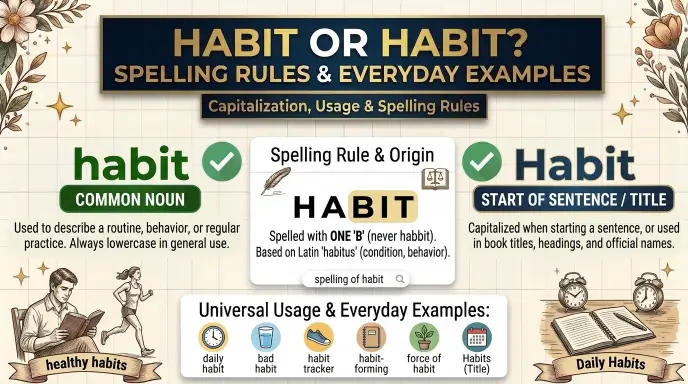
The word habit has only one b. Adding another “b” creates the incorrect spelling habit.
Remember this simple rule:
HABIT
Correct
H A B I T
HABBIT
Incorrect
H A B B I T
Quick tip: Always write habit with one “b.”
The Origin of Habit or Habit
The word habit has a long history. It comes from Latin and has been used in English for many years.
Where Does the Word Habit Come From?
The word habit comes from the Latin word habitus. It means a condition, state, or way of being.
It is linked to the Latin verb habere, which means “to have” or “to hold.”
The word later entered English through Old French. Over time, its meaning became linked to regular actions and behavior.
Today, a habit means something a person does often or regularly.
Why Does Habit Have One B?
The correct spelling has one “b” because English kept the single-b form of the word.
Some learners write habit because they think the middle sound needs two letters. This is a spelling error, not a different English form.
There is no historical spelling rule that changes habit to habit in modern English.
How Has the Meaning Changed?
The word has been used in different ways over time.
- Earlier use: A condition, state, or way of being.
- Later use: A person’s regular behavior or practice.
- Modern use: An action that someone repeats often.
Example: Brushing your teeth every morning is a daily habit.
British English vs American English Spelling
There is no spelling difference between British and American English for the word habit.
Both forms use the same spelling. The incorrect form habit is not accepted in either variety.
British English Spelling
British English uses a habit with one “b.”
Examples:
- Reading books is a useful habit.
- He has a habit of drinking tea.
- Good habits can improve your daily life.
American English Spelling
American English also uses a habit with one “b.”
Examples:
- Exercise is a healthy habit.
- She has a habit of checking her phone.
- Good habits help children learn.
British vs American Spelling Comparison
| Word | British English | American English |
| Habit | Habit | Habit |
| Habbit | Incorrect | Incorrect |
| Habits | Habits | Habits |
| Habitual | Habitual | Habitual |
| Habitually | Habitually | Habitually |
| Habit-forming | Habit-forming | Habit-forming |
Important rule: The spelling habit stays the same in both British and American English. Always use one “b.”
Which Spelling Should You Use?
The correct spelling depends on the standard English rules, not your location. Whether you write for American, British, or international readers, use habit.
For American English Readers
Use habit in schoolwork, emails, books, and online content.
Examples:
- Walking every day is a healthy habit.
- He wants to break his bad habit.
- She has a habit of reading at night.
For British English Readers
British readers also use the spelling habit.
Examples:
- Eating well is a good habit.
- My brother has a habit of staying up late.
- Regular exercise is a healthy habit.
For Commonwealth Countries
People in Pakistan, India, Australia, Canada, and other Commonwealth countries use this habit.
Examples:
- Good habits help students succeed.
- Smoking is a harmful habit.
- Reading daily is a useful habit.
For Global English
If you write for an international audience, follow these simple rules:
- Write habit, not habit.
- Use habits when talking about more than one.
- Use habitual as an adjective.
- Use habitually when describing a repeated action.
Professional advice: Always use habits in formal writing, academic work, business emails, and website content. The spelling does not change by country.
Common Mistakes with Habit or Habit
Many English learners write habit by mistake. The extra “b” is not needed.
Here are some common errors and their correct forms.
1. Adding an Extra B
Incorrect
Reading is a good habit.
Correct
Reading is a good habit.
Meaning: Reading often is a useful daily action.
2. Using Habit in a Sentence
Incorrect
I have a habit of waking up early.
Correct
I have a habit of waking up early.
Meaning: Waking up early is something you do regularly.
3. Misspelling the Plural Form
Incorrect
Good habits make life better.
Correct
Good habits make life better.
Meaning: Use habits when talking about more than one habit.
4. Confusing Habit with Habitual
Incorrect
He has a habit of eating late.
Correct
He has a habit of eating late.
Meaning: Habit is a noun. Habitual is an adjective.
5. Using the Wrong Form in Formal Writing
Incorrect
The student has developed a bad habit.
Correct
The student has developed a bad habit.
Meaning: The correct spelling makes your writing clear and professional.
Easy Ways to Remember the Correct Spelling
- Habit: One “b” is correct.
- Habits: Add “s” for more than one.
- Habitual: Add “ual” to form an adjective.
- Habitually: Add “ually” to describe repeated behavior.
Remember: Habit has one B, not two.
Habit or Habit in Everyday Examples
The word habit is common in daily English. You can use it in emails, news, social media, and formal writing.
1. In Emails
Use habits when talking about regular actions or routines.
Examples:
- I am trying to build a habit of reading daily.
- Please make it a habit to check your emails.
- Good work habits can improve team results.
2. In News Articles
News writers use this habit when discussing health, behavior, and daily life.
Examples:
- Experts say that healthy habits can improve well-being.
- Poor eating habits may affect children’s health.
- Many people are trying to break the habit of smoking.
3. On Social Media
People often use this habit when sharing personal goals and daily routines.
Examples:
- Reading every day is my favorite habit.
- Small habits can create big changes.
- I am building better habits this year.
4. In Formal Writing
Use habits in reports, essays, research, and professional documents.
Examples:
- Regular exercise is a healthy habit.
- The study examines changes in human habits.
- Students should develop good study habits.
5. In Everyday Conversations
You can also use this habit when talking with friends and family.
Examples:
- I have a habit of drinking coffee every morning.
- Stop biting your nails. It is a bad habit.
- My father has a habit of walking after dinner.
Habit or Habit :Google Trends & Usage Data

People search for habit or habit because they want to know the correct spelling. Both forms look similar, but only habit is correct in standard English.
Google Trends can help show how people search for these words. It can also show interest by country and over time.
Which Word Is More Popular?
Habit is the correct and standard spelling. Habit is a common spelling error.
People may search for a habit when they are unsure about the correct spelling. Others search for habit meaning, good habits, or bad habits to learn more about the word.
Do not treat a spelling mistake as a separate English word.
Search Interest by Country
People in many countries use English and may search for this spelling question.
Some useful markets to explore include:
- United States: Daily habits, healthy routines, and English spelling.
- United Kingdom: Correct spelling and everyday vocabulary.
- Canada: English learning and personal habits.
- Australia: Healthy habits and writing questions.
- India: English spelling, grammar, and vocabulary.
- Pakistan: English learning and common spelling mistakes.
These are suggested research markets, not a verified ranking of search volume.
Popular Related Search Terms
| Search Term | Search Intent |
| Habit or habit | Find the correct spelling |
| Habit meaning | Understand the word |
| Good habits | Learn positive routines |
| Bad habits | Understand harmful actions |
| Daily habits | Learn about daily routines |
| Healthy habits | Improve daily life |
| Habit examples | See the word in sentences |
| How to spell habit | Check correct spelling |
How to Check Google Trends Data
You can compare both spellings with Google Trends: Habbit vs Habit.
Follow these steps:
- Open the Google Trends comparison.
- Select your preferred country.
- Choose the last 12 months or five years.
- Compare habit and habit.
- Check interest over time and related searches.
Important: Google Trends uses a scale from 0 to 100. It shows relative search interest, not exact search counts. Very low-volume searches may show zero
. Exact spelling searches should be compared as search terms, because Google Trends may treat spelling variations separately.
Trends Help+2
Habit vs Habit :Comparison Table
Here is a simple side-by-side comparison of both spelling variations.
| Feature | Habbit | Habit |
| Spelling | Incorrect | Correct |
| Meaning | No standard meaning | Regular action or behavior |
| Grammar | Incorrect form | Noun |
| British English | Incorrect | Correct |
| American English | Incorrect | Correct |
| Plural form | Habits (incorrect) | Habits |
| Example | Bad habit | Bad habit |
| Formal writing | Avoid | Recommended |
Final answer: Always use habits. The spelling habit is incorrect.
Frequently Asked Questions
1. Is it habit or habit?
Habit is the correct spelling. Habit is a spelling mistake. Always write the word with one “b.”
2. What does habit mean?
A habit is something you do often or regularly. It can be good or bad.
Example: Brushing your teeth every morning is a good habit.
3. Why is habit incorrect?
The correct English spelling contains only one “b.” Adding another “b” creates an incorrect spelling.
4. Is habit the same in British and American English?
Yes. Both British and American English use this habit. There is no difference in spelling.
5. What is the plural of habit?
The plural of habit is habits.
Example: Good habits can help children learn better.
6. How do you use habit in a sentence?
You can use habit to describe something you do regularly.
Examples:
- Reading is a good habit.
- He has a habit of talking loudly.
- Exercise is part of my daily habit.
7. What is the difference between habit and habitual?
Habit is a noun. It means a regular action or behavior. Habitual is an adjective. It describes something that happens regularly.
Examples:
- Reading is a good habit.
- He is a habitual late sleeper.
8. How can I remember the spelling of habit?
Remember that habit has only one B. Do not add another “b” when writing the word.
Conclusion
Choosing between habit or habit is easy once you know the correct spelling. The word habit is always correct in standard English. It means something you do often or regularly.
These actions can be good, such as reading books, exercising, and eating healthy food. They can also be bad, such as smoking or biting your nails.
The spelling habit is incorrect because the word needs only one “b.” This rule applies to British English, American English, and other English-speaking countries. There is no regional spelling difference.
When writing emails, schoolwork, articles, or business documents, always use habits. Remember its related forms, such as habits, habitual, and habitually.
Learning these forms can also improve your English vocabulary.
The easiest way to remember this word is simple: Habit has one B, not two. Keep this rule in mind, and you will avoid this common spelling mistake in your everyday writing.
Discover More Articles!
Cheak or Cheek: Which Is Correct? Meaning and Examples(2026)
Abscent or Absent: Correct Spelling and Meaning(2026)

I’m Michaelswal, an English grammar enthusiast passionate about helping people improve their writing and communication skills. I share simple, clear, and practical grammar tips to make learning English easier and more enjoyable.