Have you ever wondered whether “cheak” or “cheek” is the correct spelling? You are not alone. Many people make this spelling mistake when writing about the face.
Both words may look possible at first. However, only one is correct in standard English.
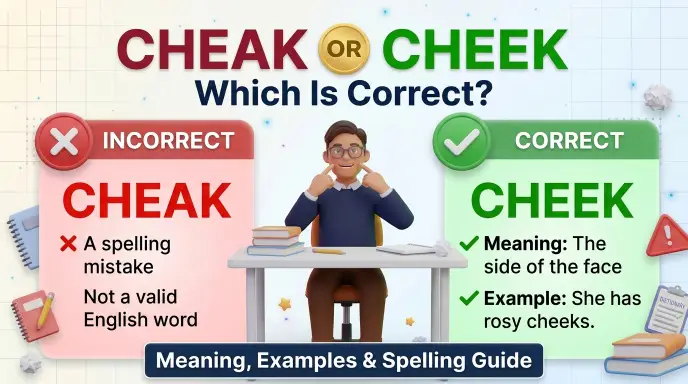
The correct spelling is cheek. The word cheak is a common spelling error. A cheek is one of the two soft parts of your face.
They sit below your eyes and on each side of your nose. For example, you can say, “She kissed the baby on the cheek.”
People often search for “cheak or cheek” because the word has a long ee sound. Some English words use “ea” for a similar sound.
This can make the spelling confusing. But cheek always uses “ee” in standard English.
In this guide, you will learn the correct spelling, meaning, and word history. You will also see clear examples and common mistakes
. We will compare British and American English and answer popular questions. By the end, you will know when and how to use your cheek with confidence.
Cheak or Cheek :Quick Answer
Cheek is the correct spelling. Cheak is incorrect in standard English.
The word cheek is a noun. It means either side of your face below your eyes. It can also describe bold or rude behavior in some expressions.
Examples:
- She had a small mark on her cheek.
- The child rested his head against his mother’s cheek.
- He kissed her on the cheek.
- It took a lot of cheek to speak to the teacher that way.
Remember: Always write cheek, not cheak, when you mean the side of the face.
The Origin of Cheak or Cheek
The word cheek has a long history in the English language. It comes from the Old English word cēace. This old word referred to the jaw or cheek area.
Over time, the spelling and pronunciation changed. The modern spelling became cheek. English spelling developed through many periods. Words often kept older spelling patterns even as their sounds changed.
The incorrect form check does not have the same accepted history as a standard spelling of this word. It usually appears because writers confuse the letters “ea” and “ee.”
English has several words with similar sounds but different spellings. For example:
- Cheek: The side of your face.
- Speak: To say words.
- Peak: The top of a mountain.
- Weak: Not strong.
- Meat: Food from an animal.
These examples show why English spelling can be confusing. Similar sounds do not always follow the same spelling pattern.
The key point is simple: the accepted spelling is cheek.
British English vs American English Spelling
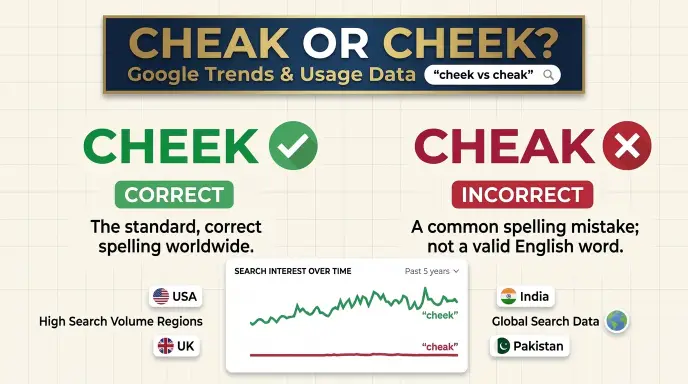
There is no spelling difference between British and American English for this word. Both forms use cheeks.
Some English words have different spellings in the United States and the United Kingdom. For example, Americans write color, while British writers often use colour. However, the cheek stays the same in both forms.
British English
British English uses cheek when talking about the face. It also uses the word in expressions about bold or rude behavior.
Examples:
- She had a red mark on her cheek.
- He had the cheek to complain again.
- The cold wind made my cheeks feel numb.
American English
American English also uses cheek. The spelling and basic meaning remain the same.
Examples:
- The little girl touched her cheek.
- He gave his friend a kiss on the cheek.
- My cheeks turned red in the cold.
British English vs American English Comparison Table
| Word or Feature | British English | American English |
| Correct spelling | Cheek | Cheek |
| Plural form | Cheeks | Cheeks |
| Pronunciation | /tʃiːk/ | /tʃiːk/ |
| Face meaning | Same | Same |
| Informal meaning | Same | Same |
| Incorrect form | Cheak | Cheak |
There is no regional spelling variation. Use cheek in both British and American English.
Which Spelling Should You Use?
You should always use cheek. The correct spelling does not change by country or audience.
However, your writing style may change based on your readers. Here is how to use the word in different regions.
For American Readers
Use cheek in schoolwork, emails, articles, and everyday writing.
Example: The doctor checked the rash on her cheek.
For British Readers
Use cheek in the same way. The spelling is identical in British English.
Example: He had a small cut on his cheek.
For Canadian and Australian Readers
Use cheek in both countries. It is also the standard spelling in other English-speaking regions.
Example: The baby had a smile on her cheek.
For Global English Readers
If your readers come from different countries, choose cheek. It is clear and widely accepted.
Professional tip: Do not use cheak as an alternative spelling. It is not a standard regional form.
Common Mistakes with Cheak or Cheek
Many writers make small spelling mistakes with words that have long vowel sounds. The word cheek is one example.
Here are common errors and their correct forms.
1. Writing Cheak Instead of Cheek
This is the main mistake. Some people use “ea” because it can make a long “ee” sound in other words.
- Incorrect: She touched her cheek.
- Correct: She touched her cheek.
2. Confusing the Sound with the Spelling
The sound of a word does not always tell you its spelling. English uses different letter groups for similar sounds.
For example:
- Cheek – the side of your face.
- Speak – to talk.
- Meat – food.
- Seat – a place to sit.
Do not assume that every similar sound uses the same letters.
3. Using Check in Formal Writing
The spelling check is not accepted in standard formal English. Avoid it in school essays, business emails, and professional documents.
- Incorrect: He kissed her on the cheek.
- Correct: He kissed her on the cheek.
4. Forgetting the Plural Form
The plural of cheek is cheeks. Add “s” when you mean both sides or more than one cheek.
- Singular: Her cheek was red.
- Plural: Her cheeks were red.
5. Confusing Cheek with Its Informal Meaning
The word cheek can also mean bold or rude behavior. This meaning is common in informal expressions.
Example: He had the cheek to ask for more money.
Here, cheek does not refer to a part of the face. It describes someone’s bold behavior.
Cheek in Everyday Examples
The word cheek appears in daily conversations and many types of writing. It can describe a part of the face or a person’s bold behavior.
Here are examples from different situations.
1. In Emails
You may use cheek when describing an injury, a mark, or a personal experience.
Example:
“Hi Sarah,
I noticed a small red mark on my cheek this morning. I will visit the clinic if it does not improve.
Best regards,
Alex”
2. In News Writing
News reports may use the word when describing an injury or an event.
Example: The player suffered a cut on his cheek during the match.
3. On Social Media
People often use cheek in casual posts and captions.
Examples:
- A little smile and rosy cheeks!
- The baby has the cutest cheeks.
- Cold weather always makes my cheeks red.
4. In Formal Writing
You can use cheek in formal writing when it fits the subject.
Example: The patient reported pain and swelling in the left cheek.
5. In Everyday Conversation
People use the word in simple daily sentences.
Examples:
- My cheek hurts.
- She kissed the baby on the cheek.
- His cheeks turned red.
- He had the cheek to interrupt me.
Tip: The meaning depends on the sentence. Most often, cheek refers to the face.
Cheak or Cheek :Google Trends & Usage Data
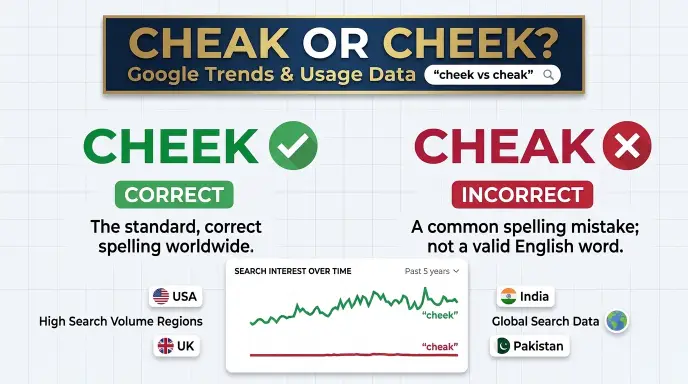
People search for “cheak or cheek” when they are unsure about the correct spelling. The confusion often comes from the similar sounds of “ea” and “ee.”
However, search interest does not prove that both spellings are correct. Cheek is the standard English spelling. Cheak is a misspelling in this context.
Search Interest by Country
People in different English-speaking countries may search for spelling help. These searches can come from students, English learners, writers, and people checking a word before publishing.
Relevant audiences may include:
- United States: People checking everyday spelling and writing.
- United Kingdom: Students and writers learning standard English.
- Canada: English learners and people checking word usage.
- Australia: Readers looking for spelling and grammar help.
- Pakistan and India: English learners checking commonly confused words.
These are possible audiences, not a verified ranking of search interest.
How to Understand Google Trends Data
Google Trends can help compare interest in search terms. It uses a relative scale from 0 to 100. This score does not show the exact number of searches.
For this keyword, a Trends comparison may include:
- Cheek: The correct spelling.
- Cheak: A possible misspelling people may search.
- Cheak or Cheek: A spelling-comparison query.
Search results can change by country, date range, and selected search category. A low score may also mean that a term has limited search activity.
Important: Do not treat an unverified graph or country list as actual search data. Use live Google Trends results before reporting exact popularity, rankings, or search numbers.
Cheak vs Cheek :Word Comparison Table
| Feature | Cheak | Cheek |
| Spelling status | Incorrect | Correct |
| Standard English word for the face | No | Yes |
| Meaning | No standard meaning in this context | Side of the face |
| British English | Incorrect | Correct |
| American English | Incorrect | Correct |
| Example | Cheek hurts | My cheek hurts |
| Should you use it? | No | Yes |
The difference is easy to remember: cheek is correct, and cheek is a spelling mistake.
Frequently Asked Questions
1. Is it Cheak or Cheek?
Cheek is the correct spelling. It means one side of your face below your eye. Cheek is incorrect when used with this meaning.
2. What does Cheek mean?
Cheek usually means either side of your face. It can also mean bold or rude behavior in informal English.
3. Is Cheak a real English word?
Cheak is not the standard spelling of the body part. It may appear as a typo, name, or unusual form in specific contexts. Use cheek in normal English writing.
4. Is Cheek spelled the same in British and American English?
Yes. Both British and American English use cheek. There is no regional spelling difference.
5. What is the plural of Cheek?
The plural form is cheeks. For example: “Her cheeks turned red.”
6. How do you pronounce Cheek?
The word cheek is pronounced /tʃiːk/. It sounds like “cheek,” with a long “ee” sound.
7. Why do people spell Cheek as Cheak?
People may confuse “ee” with “ea.” Both letter groups can make similar sounds in English words. However, the correct spelling of this word is always cheek.
Conclusion
The choice between cheek or cheek is simple. Cheek is the only correct standard spelling when you mean the side of your face. The spelling check is a common error and should not appear in normal English writing.
The word cheek has the same spelling in British and American English. It also stays the same in Canada, Australia, and other English-speaking regions. You do not need to change it for a different audience.
Remember that cheek has two common uses. It can name a part of the face. It can also describe bold or rude behavior in informal expressions. The sentence helps readers understand the meaning.
If you are writing an email, school essay, social media post, or formal report, choose cheek. A simple spelling check can prevent this small mistake
. Keep the correct form in mind: C-H-E-E-K. With this spelling, your writing will be clear, correct, and easy to understand.
Discover More Articles!
Plack or Plaque in English: Correct Usage With Examples(2026)
Steem or Steam: Which Spelling Is Correct?(2026)

I’m Michaelswal, an English grammar enthusiast passionate about helping people improve their writing and communication skills. I share simple, clear, and practical grammar tips to make learning English easier and more enjoyable.






1 thought on “Cheak or Cheek: Which Is Correct? Meaning and Examples(2026)”