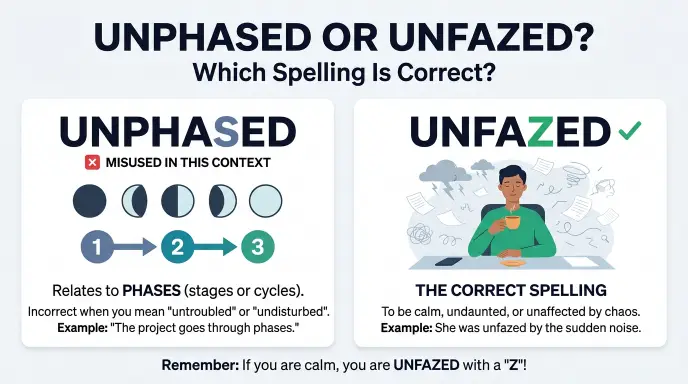
Have you ever wondered whether to write unphased or unfazed? These words look and sound similar, so many people mix them up.
However, they have different meanings. Choosing the right word can make your writing clearer and more professional.
The correct word for someone who stays calm during a difficult or surprising situation is unfazed.
It means that a person is not worried, upset, or surprised by something. For example, “She remained unfazed by the loud noise.”
The word unphased is also a real word, but it has a different meaning. It usually describes something that is not divided into phases or stages. It is much less common in everyday writing.
People search for “unphased or unfazed” because they want to know which word fits their sentence. This guide explains both words in simple English. You will learn their meanings, origins, spelling rules, and common uses.
You will also see examples from emails, news articles, and social media. By the end, you will know when to use each word and how to avoid this common mistake.
Unphased or Unfazed : Quick Answer
Unfazed is the correct choice when you mean calm, relaxed, or not bothered by something.
Unphased can be correct in technical contexts when something is not divided into phases or stages. It is not the usual word for staying calm.
Examples:
- Unfazed: He remained unfazed by the criticism.
- Unphased: The project was described as unphased because it had no separate stages.
In most everyday situations, use unfazed when describing a person who is not worried or disturbed.
The Origin of Unphased or Unfazed
The words “unfazed” and “unphased” come from different base words.
The Origin of Unfazed
“Unfazed” comes from the verb faze, which means to disturb, worry, or upset someone. The prefix “un-” means “not.” So, “unfazed” means not disturbed or worried.
For example:
- She was unfazed by the challenge.
- He looked unfazed after hearing the news.
The word “faze” became common in English in the nineteenth century. Today, “unfazed” is widely used in everyday speech and writing.
The Origin of Unphased
“Unphased” comes from the noun phase, which means a stage or part of a process. The suffix “-ed” forms an adjective meaning that something has been placed into, or described in terms of, phases.
With the prefix “un-,” the word can mean not divided into phases or not organized by stages.
For example:
- The work followed an unphased schedule.
- The process remained unphased rather than being split into stages.
This use is less common and may sound technical. In many contexts, “not divided into phases” is clearer.
British English vs American English Spelling
British and American English sometimes use different spellings. For example, American English uses “center,” while British English often uses “centre.”
However, unfazed has the same spelling in both British and American English. The less common word “unphased” is also spelled the same way in both varieties when it is used with its technical meaning.
| Word | American English | British English |
| Unfazed | Correct | Correct |
| Unphased | Possible in technical contexts | Possible in technical contexts |
| Unphazed | Incorrect | Incorrect |
| Unfaised | Incorrect | Incorrect |
Why Do People Confuse These Words?
The words sound alike, but their base words differ:
- Faze means to disturb or worry.
- Phase means a stage in a process.
The spelling “unfazed” is linked to feelings and reactions. The spelling “unphased” is linked to phases or stages.
Examples in Both English Styles
American English: She was unfazed by the difficult question.
British English: She was unfazed by the difficult question.
Both sentences use the same spelling and meaning.
Which Spelling Should You Use?
Your choice depends on what you want to say.
Use Unfazed for People and Reactions
Choose “unfazed” when someone stays calm or does not seem bothered.
Examples:
- The teacher was unfazed by the noise.
- She remained unfazed after the setback.
- He seemed unfazed by the sudden change.
This is the word you will need most often in everyday writing.
Use Unphased for Phases or Stages
Choose “unphased” only when you mean that something is not divided into phases or stages.
Examples:
- The work was planned as an unphased process.
- The project used an unphased approach rather than separate stages.
Because “unphased” is uncommon, consider using a clearer phrase, such as “not divided into phases.”
Advice for a Global Audience
For readers in the United States, the United Kingdom, Canada, Australia, and other English-speaking regions, the meaning stays the same.
If you are describing a calm person, use “unfazed.” If you are writing about a process that has no separate stages, “unphased” may fit, but make the intended meaning clear.
For if writing, explain the difference early. Include natural examples and avoid using the words as if they mean the same thing.
Common Mistakes with Unphased or Unfazed
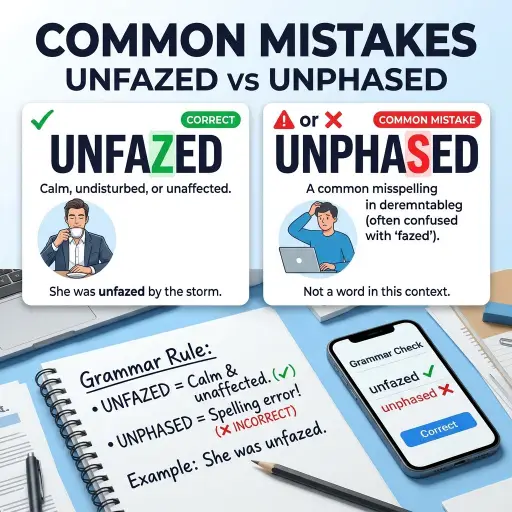
These words are easy to mix up. Here are common errors and ways to correct them.
Mistake 1: Using Unphased to Mean Calm
Incorrect: She was unphased by the bad news.
Correct: She was unfazed by the bad news.
Use “unfazed” when a person is not upset or worried.
Mistake 2: Thinking Unphased Is Always Wrong
“Unphased” is not always wrong. It can be used when talking about something that is not split into phases.
Example: The team chose an unphased rollout.
However, this wording is uncommon. “A rollout that was not divided into phases” may be easier to understand.
Mistake 3: Writing Unphazed
Incorrect: He remained unphazed by the pressure.
Correct: He remained unfazed by the pressure.
The correct spelling uses an “f,” not “ph.”
Mistake 4: Confusing Faze with Phase
Remember the difference:
- Faze: To disturb or worry someone.
- Phase: A stage in a process.
Examples:
- The comment did not faze her.
- The project entered its next phase.
This simple rule can help you choose the correct word.
Mistake 5: Using Unfazed for Every Situation
“Unfazed” describes a lack of worry or disturbance. It does not mean that a person never feels emotions.
Example: He was unfazed by the delay, but he was still disappointed.
Use the word only when it matches the situation.
Unphased or Unfazed in Everyday Examples
Both words can appear in writing, but their uses are different.
1. In Emails
Unfazed:
Hi Team,
The client raised several concerns, but Maria remained unfazed and answered each question clearly.
Best regards,
Alex
2. In News Articles
Unfazed:
The athlete remained unfazed by the pressure and finished the race strongly.
Unphased:
The report described the work as an unphased process, with no separate stages.
The second example uses “unphased” in a technical sense.
3. On Social Media
Unfazed:
“Everyone was worried, but she stayed completely unfazed!”
This is a natural and common use of the word.
4. In Formal Writing
Unfazed:
The manager remained unfazed by the unexpected results.
Unphased:
The team selected an unphased approach to the work.
In formal writing, explain the meaning of “unphased” if readers may not know the term.
5. In Everyday Conversation
- I was unfazed by the rain.
- He seemed unfazed by the criticism.
- The change did not faze her.
- The plan was not divided into phases.
These examples show why “unfazed” is the usual choice when talking about feelings or reactions.
Unphased or Unfazed : Google Trends and Usage Data
People search for “unphased or unfazed” because the words sound alike and are easy to confuse.
In everyday English, unfazed is the common word for someone who is calm or not bothered. “Unphased” is much less common and usually appears in technical discussions about stages or phases.
Search interest can vary by country, topic, and time. Without checking current data, it would not be accurate to give exact search volumes or claim that one country uses one spelling more often.
You can compare interest in both terms using Google Trends. Enter “unfazed” and “unphased,” then choose a country and date range.
You can explore results for the United States, United Kingdom, Canada, Australia, or worldwide.
Keep in mind that Google Trends shows relative search interest, not exact search counts. Searches for “unphased” may include people checking whether it is a spelling mistake.
For if content, answer the main question early. Explain both meanings and give clear examples. This helps readers choose the right word and understand why the two spellings are different.
Comparison Table: Unphased vs Unfazed
| Feature | Unfazed | Unphased |
| Is it a real word? | Yes | Yes, in limited contexts |
| Main meaning | Not worried or disturbed | Not divided into phases or stages |
| Common in daily English | Yes | No |
| Describes a person’s reaction | Yes | Usually no |
| Used in technical writing | Sometimes | Sometimes |
| British spelling | Unfazed | Unphased |
| American spelling | Unfazed | Unphased |
| Example | She was unfazed by the news. | The plan used an unphased approach. |
Key takeaway: Use “unfazed” for calm reactions. Use “unphased” only when you mean something is not divided into phases.
FAQs About Unphased or Unfazed
1. Is unphased or unfazed correct?
Both are real words, but they have different meanings. “Unfazed” means not worried or disturbed. “Unphased” can mean not divided into phases or stages.
2. Does unfazed mean not bothered?
Yes. “Unfazed” describes someone who is not worried, upset, or disturbed by something.
3. Is unphased a spelling mistake?
Not always. It can be used in technical contexts about phases or stages. However, it is incorrect if you mean calm or not bothered. In that case, use “unfazed.”
4. Is unfazed correct in British and American English?
Yes. “Unfazed” is the standard spelling in both British and American English.
5. What is the difference between faze and phase?
“Faze” means to disturb or worry someone. “Phase” means a stage in a process.
6. How do I use unfazed in a sentence?
You can write, “She remained unfazed by the criticism.” This means the criticism did not seem to upset or worry her.
7. What is an easy way to remember unfazed?
Think of “faze” as a word about feelings. If something does not faze you, it does not upset or worry you. So, you are “unfazed.”
Conclusion
The difference between unphased and unfazed comes down to meaning. “Unfazed” means calm, untroubled, or not bothered by something.
It is the right word when you describe a person who handles pressure without showing worry. For example, “She remained unfazed by the difficult questions.”
“Unphased” is also a real word, but it has a less common meaning. It can describe something that is not divided into phases or stages.
For example, a project may use an unphased approach instead of moving through separate stages. In many cases, the phrase “not divided into phases” is clearer.
Neither word is a special British or American spelling. The same meanings and spellings apply in both forms of English.
When writing emails, school assignments, articles, or social media posts, choose the word that matches your meaning.
If you are talking about feelings or reactions, use “unfazed.” If you are talking about stages in a process, “unphased” may fit. Remember this simple rule, and you can avoid a common spelling mistake.
Discover More Articles!
Selling or Saling: Which Spelling Is Correct?(2026)
Summited or Submitted: Which Spelling Is Correct?(2026)

I’m Michaelswal, an English grammar enthusiast passionate about helping people improve their writing and communication skills. I share simple, clear, and practical grammar tips to make learning English easier and more enjoyable.








2 thoughts on “Unphased or Unfazed: Which Spelling Is Correct?(2026)”