Have you ever wondered if to write abscent or absent? You are not alone. Many English learners and writers confuse these two spellings.
They look similar and sound almost the same. However, only one is correct in standard English.
The correct spelling is absent. The word abscent is a common spelling mistake. People often add an extra letter because of the way they hear or pronounce the word.
This can happen when writing emails, school assignments, office reports, or everyday messages.
Knowing the correct spelling helps you write with more confidence. It also makes your writing look clear and professional.
if you use American English, British English, or another form of English, the correct spelling remains the same.
In this guide, you will learn the meaning of absent, its origin, and its correct use
. You will also see simple examples, common mistakes, and answers to frequently asked questions. By the end, you will know exactly when and how to use this word.
Abscent or Absent :Quick Answer
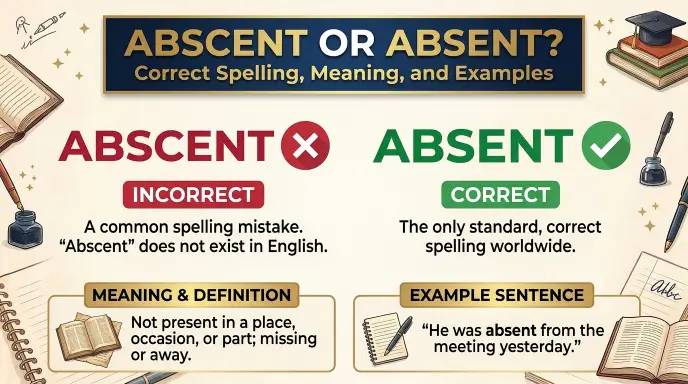
Absent is the correct spelling. Abscent is incorrect and does not have a standard English meaning.
The word absent means not present in a place or situation. It can describe someone who is missing from school, work, a meeting, or another event.
Correct: She was absent from school yesterday.
Incorrect: She was abscent from school yesterday.
Here is a quick look at both spellings:
| Word | Correct or Incorrect | Meaning |
| Absent | Correct | Not present |
| Abscent | Incorrect | Common spelling mistake |
Examples of absent:
- Tom was absent from the meeting.
- Three students were absent today.
- My manager is absent this week.
- The teacher marked him absent.
- She was absent due to illness.
Easy tip: Remember that absent has no letter C. Write it as A-B-S-E-N-T every time.
The Origin of Absent or Abscent
The word absent has a long history. It comes from the Latin word absens. This Latin word means being away or not present.
It developed from two Latin parts:
- Ab: Away or from.
- Esse: To be.
Together, these parts express the idea of being away.
The word later entered English through Old French and Latin influences. It became a common word for describing someone who was not present.
Over time, people began using absent in many situations. It can describe missing people, things, or qualities.
For example:
- The student was absent from class.
- His name was absent from the list.
- There was an absent look in her eyes.
- The report was absent of important details.
Why Do People Write Abscent?
The spelling abscent is usually caused by confusion. Some people add the letter C because they connect the word with the sound of other English words.
Words such as descent and ascent may also create confusion. However, these words follow different spelling patterns.
Remember: The correct word is always absent, not abscent.
British English vs American English Spelling

Some English words have different spellings in British and American English. For example, British writers use colour, while American writers use color.
However, absent has the same spelling in both English styles.
There is no British or American spelling difference for this word.
Spelling Comparison Table
| English Type | Correct Spelling | Example |
| British English | Absent | He is absent today. |
| American English | Absent | She was absent yesterday. |
| Canadian English | Absent | Two workers are absent. |
| Australian English | Absent | The student was absent. |
| Global English | Absent | I was absent from work. |
British English Examples
- The pupil was absent from school.
- Several workers were absent today.
- He remained absent during the meeting.
American English Examples
- The student was absent on Monday.
- My friend is absent from work.
- She was marked absent by her teacher.
Important: British and American writers both use absent. Neither spelling requires an extra C.
Which Spelling Should You Use?
You should always use absent in standard English writing. Your choice does not depend on your country or audience.
However, the way you use the word can depend on the situation.
1. For American English
Use absent in schoolwork, business emails, reports, and daily writing.
Example: John was absent from the office yesterday.
2. For British and Commonwealth English
Use the same spelling in British, Australian, Canadian, and other Commonwealth writing.
Example: The pupil was absent from class.
3. For International English
Use absent when writing for a global audience. It is understood across different English-speaking countries.
Example: Two team members are absent today.
4. For Professional Writing
Use absent in formal reports, workplace messages, and official documents.
Example: The employee was absent due to personal reasons.
Final advice: There is no need to choose between British and American spelling. Absent is correct everywhere.
Common Mistakes with Abscent or Absent
Many writers make small spelling mistakes when using this word. Most errors happen because people rely on pronunciation instead of correct spelling.
Here are some common mistakes and their corrections.
1. Adding an Extra C
Incorrect: The teacher was abscent today.
Correct: The teacher was absent today.
The letter C does not belong in absent.
2. Confusing Absent with Absence
These words are related, but they have different uses.
- Absent: An adjective describing someone who is not present.
- Absence: A noun describing the state of being away.
Examples:
- He is absent from school.
- His absence surprised everyone.
3. Using Absent Without the Right Preposition
Writers sometimes use the wrong preposition after absence.
Incorrect: She was absent at school.
Better: She was absent from school.
The phrase absent from is common when describing a place or event someone missed.
4. Confusing Absent with Not Available
Absent usually describes someone or something that is not present. It does not always mean unavailable.
Example: The manager is absent from the office today.
This means the manager is not physically present.
5. Misspelling the Word in Formal Emails
An incorrect spelling can make professional writing look careless.
Incorrect: I will be abscent tomorrow.
Correct: I will be absent tomorrow.
Always check the spelling before sending important messages.
Quick Correction Table
| Incorrect Form | Correct Form |
| Abscent | Absent |
| Absence | Absence |
| Absence | Absence |
| Absant | Absent |
| Absented | Usually absent (depending on intended meaning) |
Best tip: Learn the difference between absence and absence. It will help you avoid many common writing errors.
Absent in Everyday Examples
The word absent appears in many everyday situations. People use it at school, work, home, and in professional communication.
Here are some natural examples.
1. Absent in Emails
You can use absent when informing someone about missing work or a meeting.
Examples:
- I will be absent from work tomorrow.
- Please note that I was absent yesterday.
- Sarah is absent due to a family emergency.
2. Absent in News Writing
News writers use absent to describe missing people, officials, or important elements.
Examples:
- Several key players were absent from the match.
- The mayor was absent from the public event.
- Important details were absent from the report.
3. Absent on Social Media
People also use it in casual posts and online messages.
.
Examples:
- Sorry, I was absent from social media yesterday.
- Our favorite player was absent from today’s game.
- I have been absent for a few days.
4. Absent in Formal Writing
In formal writing, absence can describe missing information, people, or qualities.
Examples:
- The required documents were absent from the file.
- The employee remained absent without notice.
- Clear evidence was absent from the investigation.
5. Absent in School and College
Teachers often use absent to record student attendance.
Examples:
- Ali was absent from class on Monday.
- Five students were absent today.
- The teacher marked the student absent.
Absent or Abscent :Google Trends and Usage Data
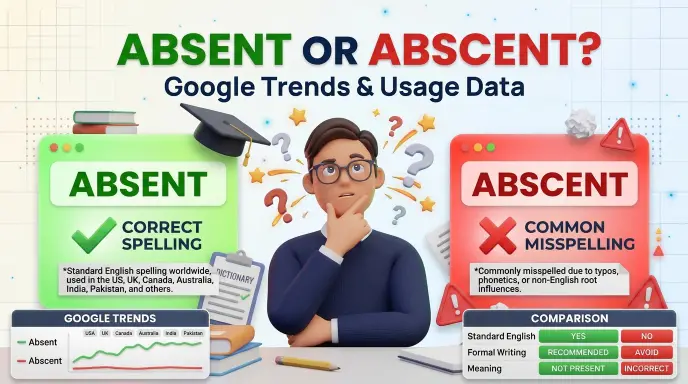
People search for abscent or absent because both forms look similar. However, only absent is accepted as the standard spelling.
Google Trends can help explain how people search for these words. It shows search interest across countries and time periods.
It is important to understand that Google Trends uses relative search interest.
Which Spelling Is More Popular?
Absent is the established English spelling. It appears in dictionaries, books, educational materials, and professional writing.
Abscent is generally a spelling error. It may appear in searches because people want to check which spelling is correct.
Search Interest by Country
The correct spelling remains the same across English-speaking regions.
| Country or Region | Correct Spelling | Common Search Intent |
| United States | Absent | Spelling and grammar checks |
| United Kingdom | Absent | Correct spelling and meaning |
| Canada | Absent | English writing questions |
| Australia | Absent | School and workplace writing |
| Pakistan | Absent | English learning and spelling |
| India | Absent | Grammar and vocabulary help |
Note: This table explains likely search contexts, not verified country rankings or measured search volumes.
Why Do People Search for Abscent?
There are several reasons behind this spelling confusion:
- Similar pronunciation: Both forms may look correct to new learners.
- Typing mistakes: People sometimes add an extra letter.
- English learning: Students often check difficult spellings.
- Writing confidence: Professionals want to avoid grammar errors.
- Search engine questions: Users want a quick answer before writing.
How to Check Google Trends
You can compare both search terms using Google Trends.
- Open Google Trends.
- Enter abscent as your first search term.
- Add absent as your second search term.
- Select your preferred country.
- Choose a suitable time range.
- Compare the search interest graph.
Remember: Search popularity does not decide correct spelling. Even if people search for abscent, the correct word remains absent.
Absent or Abscent :Word Variations Comparison Table
The word absent has several related forms. Learning these forms can improve your spelling and grammar.
| Word | Word Type | Meaning | Example |
| Absent | Adjective | Not present | He is absent today. |
| Absence | Noun | The state of being away | Her absence was noticed. |
| Absentia | Noun | Being away, often in a formal phrase | He was judged in absentia. |
| Absentee | Noun | A person who is absent | The absentee missed class. |
| Absenteeism | Noun | The habit of being absent | Absenteeism affects attendance. |
| Absently | Adverb | Without paying attention | She nodded absently. |
| Absented | Verb form | Past tense or participle of absent oneself | He absented himself from the meeting. |
| Abscent | Incorrect | Nonstandard misspelling | Use absent instead. |
Important: These words are related, but they are not always interchangeable. Choose the form that fits your sentence.
Frequently Asked Questions
1. Is it abscent or absent?
Absent is the correct spelling. Abscent is a common spelling mistake and should not be used in standard English.
2. What does absent mean?
Absent means not present in a particular place or situation. For example, a student who does not attend class is absent.
3. Why do people spell absent as abscent?
People may add the letter C because of pronunciation confusion. However, the correct spelling has no C.
4. Is absent the same in British and American English?
Yes. Both British and American English are absent. There is no spelling difference between these varieties.
5. What is the difference between absent and absence?
Absent is an adjective, while absence is a noun.
Examples:
- She is absent today.
- Her absence was unexpected.
6. What is the opposite of absent?
The opposite of absent is present. Present means someone or something is in a particular place.
Example: All students were present today.
7. Can I use absent in a professional email?
Yes. Absent is suitable for professional emails, reports, and workplace messages.
Example: I will be absent from the office tomorrow due to a personal matter.
Conclusion
Choosing between abscent or absent is simple once you learn the correct spelling. Absent is always correct, while abscent is a common spelling error. The word means not present in a place, event, or situation.
You can use absent in school assignments, office emails, news reports, and everyday conversations. It works in both British and American English. There is no regional spelling difference to remember.
It is also helpful to understand related words. Absence is a noun, while absent is an adjective. Both words have different roles in a sentence. Learning this difference can make your writing clearer and more accurate.
Remember one simple rule: Absent has no letter C. This small spelling tip can help you avoid a common mistake
. if you are writing for school, work, or online readers, always choose absent. Correct spelling builds confidence and makes your English easier to understand
Discover More Articles!
Prepair or Prepare: Which Is Correct? Meaning and Examples
Surprise or Surprize: Correct Spelling Explained(2026)

I’m Michaelswal, an English grammar enthusiast passionate about helping people improve their writing and communication skills. I share simple, clear, and practical grammar tips to make learning English easier and more enjoyable.