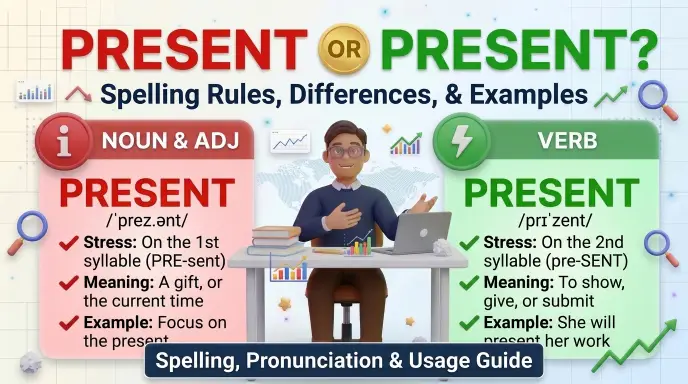
Have you ever typed present or present and wondered which word is right? You are not alone. These words look almost alike, but they have very different uses. Choosing the wrong one can change the meaning of your sentence.
The word present is common in everyday English. It can mean a gift, the time happening now, or a person who is in a place
. It can also mean to show or give something. The word present is much less common. It means to lead people in singing, often during a church service.
Many people search for these words because they are unsure about their spelling. Students may need the right word for schoolwork.
Writers may want to avoid errors in emails, articles, and reports. English learners may also find the two words confusing.
In this guide, you will learn the difference between present and present. You will find their meanings, origins, spelling rules, and simple examples
. You will also learn when to use each word in everyday writing.
Present or Present :Quick Answer
Both present and present are correct English words. However, they have different meanings.
| Word | Meaning | Usage |
| Present | A gift, now, being there, or showing something | Common everyday English |
| Precent | To lead a group in singing | Rare; mainly church music |
Examples of Present
- I bought a birthday present for my brother.
- She is present in the classroom.
- We should enjoy the present moment.
- The teacher will present the awards.
Examples of Percent
- The church leader will present the hymn.
- He was asked to present during the service.
Quick answer: Use presents for gifts, time, attendance, and showing something. Use present only when talking about leading a group in singing.
The Origin of Present or Present
Although these words look similar, they have different histories. Their meanings also developed in different ways.
The Origin of Present
The word present comes from Old French present and Latin praesens. The Latin word described something or someone that was nearby or at hand.
The word later became part of English. It developed several meanings over time.
- As a noun: A gift given to someone.
- As an adjective: Someone who is there or something happening now.
- As a verb: To show, offer, or give something.
For example, a birthday present is a gift. A person who attends a meeting is present. A speaker may present a new idea.
The Origin of Percent
The word present has a special history. It is linked to the Latin word praecinere, which means to sing before or lead singing.
It is also related to the word precentor. A precentor is a person who leads singing, often in a church.
Today, present is a rare verb. It is mainly used in religious and musical settings.
Why Do People Confuse These Words?
There are several reasons:
- Both words contain almost the same letters.
- Only one letter changes their spelling.
- Many people know present but rarely see present.
- Fast typing can lead to spelling errors.
- Their meanings are not easy to guess from their appearance.
Remember: Present is a common English word. Percent has a special meaning related to leading songs.
British English vs American English Spelling
British English and American English use the same spelling for present and present. Neither word changes its spelling between these varieties.
The main difference is not regional. It is about meaning and use.
For example, British and American writers use presents when talking about gifts, meetings, and current time. Both can also use precedent when discussing church singing.
British English vs American English Comparison
| Feature | British English | American English |
| Gift | Present | Present |
| Current time | Present | Present |
| Attendance | Present | Present |
| Showing something | Present | Present |
| Leading church singing | Precent | Precent |
| Spelling difference | None | None |
British English Examples
- I bought a lovely present for my mother.
- All students were present today.
- The headteacher will present the awards.
American English Examples
- She received a birthday present.
- He was present at the meeting.
- The manager will present the new plan.
Important: There is no British or American spelling difference here. Both varieties use the same forms.
Which Spelling Should You Use?
The right word depends on your sentence. Your country does not change the correct spelling.
Here is how to choose the right word for different readers.
1. American English
Use presents for gifts, time, attendance, and giving information.
Example: I bought a special present for my daughter.
2. British English
Use present in everyday writing, schoolwork, and business messages.
Example: All team members were present at the meeting.
3. Canadian and Australian English
Use present for normal daily meanings. The spelling is the same in these countries.
Example: She gave her friend a beautiful present.
4. Global English
Use present in most everyday situations. Choose present only when discussing someone who leads a group in singing.
Example: The church leader will present the hymn.
Professional advice: If you are writing an article, email, school assignment, or business report, you will usually need a present. Do not use present as an alternative spelling.
Common Mistakes with Present or Present
These words can cause spelling mistakes because they look almost identical. However, their meanings are not interchangeable.
Here are some common errors and their corrections.
| Incorrect Sentence | Correct Sentence |
| I bought a birthday present. | I bought a birthday present. |
| Enjoy the present moment. | Enjoy the present moment. |
| All students were present. | All students were present. |
| She will present her project. | She will present her project. |
| The church leader will present the hymn. | The church leader will present the hymn. |
1. Using Percent for a Gift
Incorrect: My father gave me a lovely present.
Correct: My father gave me a lovely present.
Use a present when talking about a gift.
2. Using Percent for the Current Time
Incorrect: We should enjoy the present.
Correct: We should enjoy the present.
The word present can describe the time happening now.
3. Using Percent for Attendance
Incorrect: All teachers were present today.
Correct: All teachers were present today.
Present means that someone is in a place.
4. Using Percent for a Presentation
Incorrect: I will present my ideas tomorrow.
Correct: I will present my ideas tomorrow.
Present means to show or explain something.
5. Confusing the Church Music Meaning
Incorrect: The choir leader will present the hymn.
Correct: The choir leader will present the hymn.
Percent means to lead a group in singing.
Easy tip: Remember the word present for normal daily writing. Use present only when its special meaning is needed.
Present or Present in Everyday Examples
Both words can appear in written English. However, the present is much more useful in daily communication.
Here are examples from different situations.
1. In Emails
People often use presents in personal and business emails.
- Thank you for the lovely present.
- All staff must be present at the meeting.
- I will present the report tomorrow.
- Please be present before the event begins.
2. In News
News writers use presents when reporting events, gifts, and announcements.
- The mayor will present a new city plan.
- Several guests were present at the event.
- The winner received a special present.
3. On Social Media
Present is common in birthday posts and personal captions.
- Thank you for this beautiful present!
- Enjoy the present and make good memories.
- I received the best birthday present today.
- Living in the present makes life better.
4. In Formal Writing
Present is useful in reports, essays, and professional documents.
- The manager will present the final report.
- All members were present during the meeting.
- This report explains the problems of the present system.
5. In Church and Religious Writing
Percent is used in a special musical setting.
- The church leader will present the hymn.
- The precentor helped the group sing together.
- She learned to present during church services.
Writing tip: Read your sentence before choosing a word. Ask yourself what you want to say. This simple habit can help you avoid spelling mistakes.
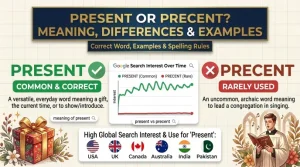
Present or Present :Google Trends & Usage Data
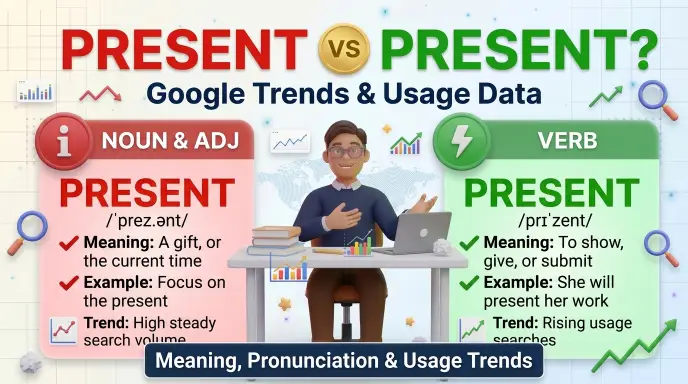
The word present has many uses in everyday English. People use it when talking about gifts, time, attendance, and public speaking.
The word present has a much smaller role. It is mainly used in church music and religious writing.
This difference in meaning helps explain why present is more familiar to most English speakers.
Usage by Country
| Country | Common Word | Common Context |
| United States | Present | Gifts, meetings, and daily writing |
| United Kingdom | Present | Gifts, attendance, and education |
| Canada | Present | Communication and schoolwork |
| Australia | Present | Everyday conversations |
| India | Present | Education and formal writing |
| Pakistan | Present | English learning and daily writing |
These examples describe common English usage. They are not measured Google search rankings.
Why Do People Search for Present?
People may search for this word for many reasons:
- Spelling help: They want to check the correct word.
- Schoolwork: Students need the right spelling for assignments.
- Gift writing: People use present in birthday messages.
- Business writing: Workers use it in emails and reports.
- English learning: Learners want to understand its meanings.
Why Is Percent Less Common?
Percent has a very specific meaning. Most people do not need it in normal conversations.
It is mainly used when talking about:
- Church services.
- Hymns and group singing.
- Choir leadership.
- Religious music.
Google Trends note: Search interest can change by country and time. Without verified Google Trends results, exact search volumes and popularity percentages should not be claimed.
Present vs Percent: Complete Comparison Table
The following table shows the main differences between these words.
| Feature | Present | Precent |
| Correct English word | Yes | Yes |
| Main meaning | Gift, now, or being there | Lead group singing |
| Part of speech | Noun, verb, adjective | Verb |
| Daily usage | Very common | Very rare |
| Business writing | Common | Unusual |
| School writing | Common | Special context |
| Related word | Presentation | Precentor |
| Example | Birthday present | Present a hymn |
Main takeaway: Both words are correct, but they have different meanings. Present is used in everyday English, while present is mainly used in church music.
FAQs About Present or Present
1. Is it present or present?
Both are correct English words. Present means a gift, the current time, or being somewhere. Prevent means to lead a group in singing.
2. Is present a real English word?
Yes. Percent is a real but rare English verb. It means to lead singing, often during a church service.
3. What does present mean?
Present has several meanings. It can mean a gift, the current time, or someone being in a place. It can also mean to show something.
4. What is the difference between present and present?
Present has several common meanings. Percent has one special meaning related to leading group singing.
5. Is present the same in British and American English?
Yes. British and American English use the same spelling. There is no regional spelling difference.
6. How do you use present tense in a sentence?
You can use presents in different ways.
Examples:
- I received a birthday present.
- She is present in class.
- He will present his ideas.
7. What is a precentor?
A precentor is a person who leads singing during a church service. This person helps the group sing hymns.
8. What is the plural of present?
The plural of present, when it means a gift, is present.
Example: My friends gave me three birthday presents.
Conclusion
Choosing between present or present becomes easy when you understand their meanings. Both are real English words, but they are used in different situations. Present is the common word.
It can mean a gift, the time happening now, or someone being in a place. It can also mean to show or give something.
On the other hand, present is a rare word. It means to lead singing, mainly during a church service. It is not a replacement for present in everyday writing.
British and American English use the same spelling for both words. There is no regional spelling change to remember
. If you are writing an email, school assignment, article, or business report, a present will usually be the right choice.
The best way to avoid mistakes is to check the meaning of your sentence. Remember that a small spelling change can create a different word.
Use present for everyday meanings and present for church singing. This simple rule will help you write clearly and correctly.
Discover More Articles!
Selling or Saling: Which Spelling Is Correct?(2026)
Unphased or Unfazed: Which Spelling Is Correct?(2026)

I’m Michaelswal, an English grammar enthusiast passionate about helping people improve their writing and communication skills. I share simple, clear, and practical grammar tips to make learning English easier and more enjoyable.




1 thought on “Present or Present: Spelling Rules, Differences, and Examples”