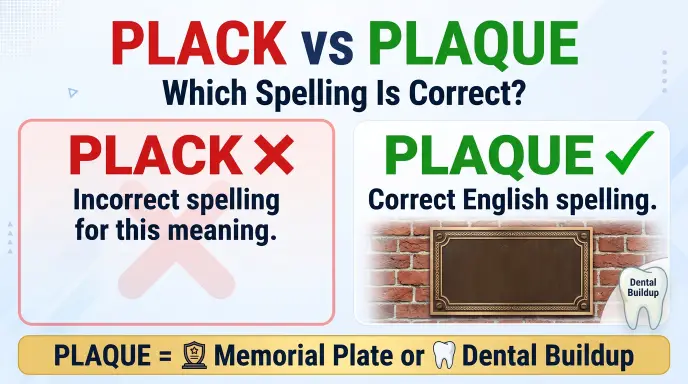
Plaque is the correct spelling when referring to a flat plate, a dental deposit on teeth, or a memorial sign. Plack is a rare word and is not a standard alternative to plaque.
People often search for plack or plaque because both words sound similar. However, their meanings and uses are different.
Choosing the wrong spelling can make your writing confusing, especially in school assignments, emails, medical discussions, and formal documents.
The most common place you will see the word plaque is at the dentist. It describes the sticky layer of bacteria that builds up on your teeth. You may also see it on a building, wall, or monument as a sign that honors a person or event.
In this guide, you will learn the correct spelling, word origins, British and American usage, common mistakes, and everyday examples. You will also discover when, if ever, the word plack is appropriate.
Plack or Plaque : Quick Answer
Plaque is the correct word in most everyday situations. It has two common meanings:
- Dental plaque: A sticky layer of bacteria that forms on your teeth.
- Memorial plaque: A flat plate with words or information, often placed on a wall or building.
Plack is a rare historical or regional word. It is not a standard replacement for plaque.
Examples:
- Correct: The dentist removed the plaque from my teeth.
- Correct: A memorial plaque was placed on the wall.
- Incorrect: I need to remove the plack from my teeth.
Easy rule: If you are talking about teeth, a memorial, or an information plate, use plaque.
The Origin of Plack and Plaque
Understanding where these words come from makes it easier to remember their spelling and meaning.
Where Does the Word Plaque Come From?
The word plaque comes from French. It is linked to the French word plaque, meaning a flat plate or slab.
It entered English in the 19th century. At first, it was mainly used for decorative or memorial plates placed on walls and buildings.
Over time, the word gained another important meaning in dentistry.
Dentists began using plaque to describe the soft layer of bacteria that collects on teeth. This is the meaning many people recognize today.
Here are some common uses:
- Dental plaque: A sticky film of bacteria on teeth.
- Memorial plaque: A plate that honors someone or remembers an event.
- Commemorative plaque: A plate that marks an important place or achievement.
- Arterial plaque: A buildup of fatty substances inside artery walls.
The same spelling is used in all these contexts, but the meaning changes with the subject.
Where Does the Word Plack Come From?
Plack is a rare word with historical and regional uses. It has appeared in older Scots and related regional vocabulary.
It is not the normal English spelling for a dental deposit or a memorial plate.
This is why people should not use plack when they mean plaque.
The two words may sound alike, but their spelling and usage are not interchangeable.
British English vs American English Spelling
There is no spelling difference between British and American English for this word.
Both British and American writers use plaque when talking about dental buildup or a flat memorial plate.
The word plack does not become correct simply because someone is writing in British English.
British vs American Comparison Table
| Meaning | British English | American English |
| Bacteria on teeth | Plaque | Plaque |
| Memorial plate | Plaque | Plaque |
| Historical regional word | Plack | Plack |
| Plaque removal | Plaque removal | Plaque removal |
| Dental hygiene | Dental plaque | Dental plaque |
Important: Always use plaque in standard English when discussing teeth, memorials, or decorative plates.
Why Do People Confuse Plack and Plaque?
There are three common reasons:
- Similar pronunciation: Both words can sound alike in everyday speech.
- Unusual spelling: The letters in plaque can make the word difficult to spell.
- Typing mistakes: People may accidentally write plack instead of plaque.
Remember that pronunciation does not always tell you the correct spelling.
Which Spelling Should You Use?
Your choice depends on what you want to describe. For almost all everyday writing, plaque is the correct choice.
If You Write for a US Audience
Use plaque when discussing dental health, memorial signs, or plaques on buildings.
Examples:
- The dentist found plaque on my teeth.
- The city placed a plaque near the monument.
- Regular brushing helps prevent plaque buildup.
If You Write for a UK or Commonwealth Audience
The same spelling applies in the United Kingdom, Australia, Canada, and other Commonwealth countries.
Examples:
- The dentist explained how plaque affects teeth.
- A blue plaque marks the historic building.
- The school placed a plaque in memory of its founder.
If You Write for a Global Audience
Choose plaque for general English writing.
If you are writing a blog post, school assignment, email, medical explanation, or news report, this is the standard spelling.
Professional writing tip: Do not use plack as a substitute for plaque. Use the standard spelling unless you are discussing the rare historical word itself.
Common Mistakes with Plack or Plaque
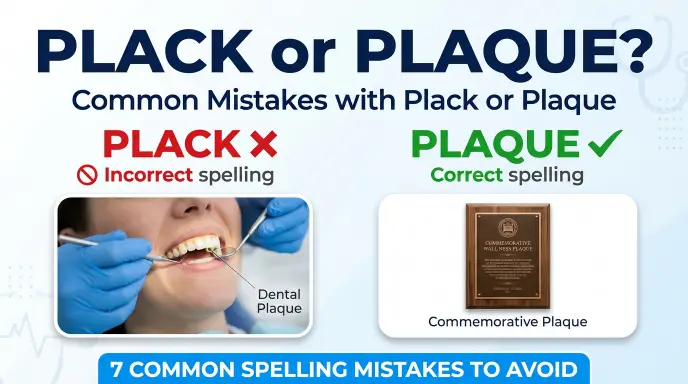
Here are some frequent spelling mistakes and their correct forms.
1. Using Plack for Dental Buildup
Incorrect: The dentist removed the plack from my teeth.
Correct: The dentist removed the plaque from my teeth.
Why? Plaque is the correct dental term for the sticky layer of bacteria on teeth.
2. Using Plack for a Memorial Plate
Incorrect: They placed a plack on the building.
Correct: They placed a plaque on the building.
Why? A plaque is a flat plate that displays information or honors someone.
3. Thinking Plack Is British English
Incorrect: Plack is the British spelling of plaque.
Correct: Plaque is used in both British and American English.
Why? These are not regional spelling variations.
4. Confusing Plaque with a Plague
Incorrect: The dentist removed the plague from my teeth.
Correct: The dentist removed the plaque from my teeth.
Why? Plaque is a dental deposit, while plague means a serious disease or something that causes widespread harm.
5. Using the Wrong Spelling in Formal Writing
Incorrect: The museum added a plack to explain the building’s history.
Correct: The museum added a plaque to explain the building’s history.
Why? Correct spelling makes professional writing clear and easy to understand.
Plack or Plaque in Everyday Examples
The best way to learn the difference is to see how the word appears in real situations.
1. In Emails
Plaque example:
“Please schedule a dental cleaning because I have noticed plaque on my teeth.”
Plaque example:
“The school plans to install a plaque to honor its former principal.”
2. In News Articles
- The hospital launched a campaign to educate people about dental plaque.
- A historic building received a new commemorative plaque.
3. On Social Media
- “I need to brush better because plaque keeps building up on my teeth!”
- “I love the new plaque outside our school. It looks beautiful!”
4. In Formal Writing
- Dental plaque can contribute to gum disease if it is not removed regularly.
- The organization installed a plaque to recognize the community’s contribution.
5. In School Assignments
- Plaque is a sticky layer of bacteria that forms on teeth.
- A memorial plaque can help people remember an important person.
6. In Medical Discussions
- Dental plaque can lead to tooth decay and gum problems.
- Arterial plaque can narrow the arteries and affect blood flow.
Quick tip: If your sentence is about teeth, health, a memorial, or a wall plate, plaque is almost always the word you need.
Plack vs Plaque : Comparison Table
| Feature | Plack | Plaque |
| Standard English word | Rare historical/regional use | Yes |
| Common spelling | No | Yes |
| Dental meaning | No | Yes |
| Memorial plate | No | Yes |
| British spelling | Not an alternative | Plaque |
| American spelling | Not an alternative | Plaque |
| Common in everyday writing | Very rare | Very common |
| Example | Historical use of plack | Dental plaque |
The main point is simple: plaque is the standard word for everyday English. Do not confuse it with plack or plague.
Frequently Asked Questions
1. Is it plack or plaque?
Plaque is the correct spelling when referring to dental buildup or a memorial plate. Plack is a rare historical or regional word and is not a standard alternative.
2. Is plack a real word?
Yes, plack has historical and regional uses, particularly in Scots vocabulary. However, it is not commonly used in modern standard English.
3. Is plaque the British or American spelling?
Plaque is the standard spelling in both British and American English. There is no regional spelling difference.
4. What does plaque mean in simple English?
Plaque has two common meanings. It can mean a sticky layer of bacteria on your teeth or a flat plate with words that honors a person or event.
5. Is plaque the same as plague?
No. Plaque usually refers to dental buildup or a memorial plate. Plague refers to a serious infectious disease or something that causes widespread trouble.
6. How do you spell dental plaque?
The correct spelling is dental plaque. It describes the sticky layer of bacteria that forms on your teeth.
7. Why do people spell plaque as plack?
People may write plack because the two words sound similar. It can also happen because plaque has an unusual spelling. However, plaque is the correct choice for standard English.
Conclusion: Plack or Plaque : Remember the Correct Spelling
Choosing between plack and plaque is easy once you understand their meanings. Plaque is the correct spelling for most everyday situations.
It refers to the sticky layer of bacteria that forms on your teeth or a flat plate that displays information or honors someone.
Plack is a rare historical or regional word. It is not a British or American alternative to plaque. Both English varieties use the same standard spelling.
If you are writing about dental care, a school project, a memorial, or a formal document, always choose plaque. Also, remember not to confuse it with plague, which has a completely different meaning.
The easiest way to remember the spelling is this: Plaque has a Q at the end, just like the correct word you need for teeth and memorial plates.
Keep this simple rule in mind, and you will avoid this common spelling mistake in your everyday writing.
Discover More Articles!
Steem or Steam: Which Spelling Is Correct?(2026)
Responsability vs Responsibility: Which Is Correct?(2026)
Surprise or Surprize: Correct Spelling Explained(2026)

I’m Michaelswal, an English grammar enthusiast passionate about helping people improve their writing and communication skills. I share simple, clear, and practical grammar tips to make learning English easier and more enjoyable.






2 thoughts on “Plack or Plaque in English: Correct Usage With Examples(2026)”