Have you ever wondered whether to write “surprize” or “surprise”? You are not alone. Many English learners and writers get confused by these two spellings.
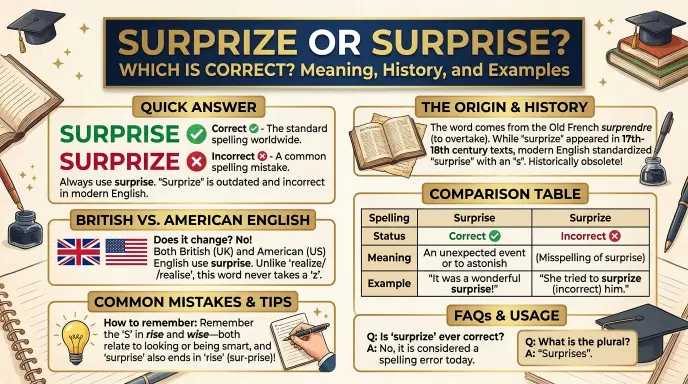
Both look almost the same, but only one is accepted in modern standard English.The correct spelling is surprise. The spelling surprize is an old variant and is not used in standard modern English.
This can make the choice confusing, especially when people see older texts or informal writing.
People often search for surprize or surprise because they want to avoid spelling mistakes. They may also wonder if British and American English use different forms.
The good news is that both countries use the same spelling today.
In this guide, you will learn the correct spelling, its meaning, and its history. You will also see simple examples and common mistakes
. We will explain how to use surprise in daily writing, emails, and formal work. By the end, you will know which spelling to choose and why it matters.
Surprize or Surprise :Quick Answer
Surprise is the correct spelling in modern English.
Surprize is an outdated spelling. It is not accepted in standard modern writing.
The word surprise means something unexpected. It can also mean the feeling you have when something happens suddenly.
Examples:
- The party was a big surprise.
- I wanted to surprise my sister.
- His visit came as a surprise.
- We planned a special surprise for our teacher.
Remember: Always use surprise in schoolwork, emails, articles, and professional writing.
The Origin of Surprize or Surprise
The word surprise has a long history. It came into English through French. The French word surprendre means to catch someone unexpectedly.
It entered English in the late Middle Ages. Early forms of the word had different spellings. This was common because English spelling was not fully fixed at that time.
Writers used forms such as surprize and surprise.
Both forms appeared in older English texts. Over time, spelling rules became more settled.
The spelling with -ise became the standard form. Today, dictionaries and modern writing guides use surprise.
Why Did the Spellings Change?
There are three main reasons:
- Old spelling habits: English spelling was less fixed in the past.
- French influence: The word came from French and changed as English adopted it.
- Modern spelling rules: Dictionaries and publishers helped make one spelling standard.
Important: The spelling surprize is not a modern British or American spelling choice. It is an old form that you may find in historical texts.
British English vs American English Spelling
Many English words have different British and American spellings. For example, British English uses colour, while American English uses color.
However, surprise is different. Both British and American English use the same spelling.
There is no standard regional difference between these two forms.
| Word | British English | American English |
| Surprise | Correct | Correct |
| Surprize | Incorrect | Incorrect |
| Surprising | Correct | Correct |
| Surprisingly | Correct | Correct |
| Surprised | Correct | Correct |
Examples in British English:
- The news came as a complete surprise.
- She was surprised by the gift.
Examples in American English:
- The result was a big surprise.
- They planned to surprise their friend.
Key Point: Both spelling systems use surprise. You do not need to change this word for a British or American audience.
Which Spelling Should You Use?
You should always use surprise in modern English. It is the accepted spelling in the United States, the United Kingdom, Canada, Australia, and other English-speaking countries.
Here is some simple advice for different audiences.
1. For American English
Use surprise in schoolwork, business writing, emails, and online content.
Example: The team planned a surprise party for their manager.
2. For British English
Use surprise in the same way. British English does not use surprize as its standard spelling.
Example: The children prepared a surprise for their parents.
3. For Canadian and Australian English
Use surprise in both countries. It is the normal spelling in everyday and formal writing.
Example: Her birthday gift was a lovely surprise.
4. For Global English
If you write for readers around the world, choose surprise. It is easy to understand and widely accepted.
Professional Advice: Do not use surprize as an alternative spelling. It may look like a typing error to modern readers.
Common Mistakes with Surprize or Surprise
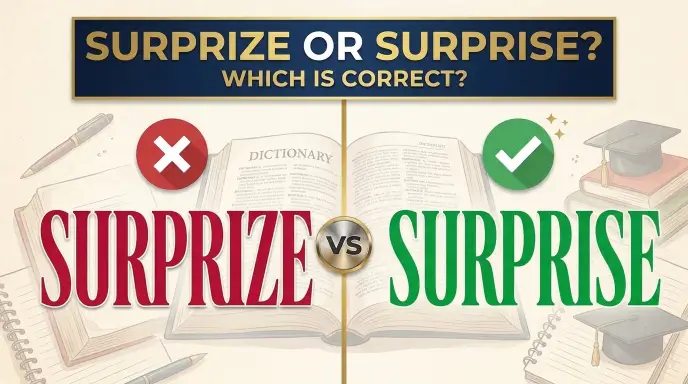
Many writers make spelling mistakes when a word has an unusual sound. The word surprise can be tricky because its pronunciation does not clearly show every letter.
Here are some common mistakes and their correct forms.
| Incorrect Spelling | Correct Spelling |
| Surprize | Surprise |
| Suprise | Surprise |
| Surprizeing | Surprising |
| Suprised | Surprised |
| Surprizing | Surprising |
| Surprizingly | Surprisingly |
1. Writing Surprize Instead of Surprise
This is the main spelling confusion. The old form may appear in historical writing, but modern English uses surprise.
Incorrect: The gift was a nice surprize.
Correct: The gift was a nice surprise.
2. Leaving Out the Letter R
Some people write suprise because they forget the second letter r.
Incorrect: I have a suprise for you.
Correct: I have a surprise for you.
3. Using the Wrong Form of the Word
The word changes when you use it in different sentences.
- Surprise: I have a surprise for you.
- Surprised: She was surprised by the news.
- Surprising: It was a surprising result.
- Surprisingly: Surprisingly, nobody was late.
Easy Tip: Remember the spelling pattern: S-U-R-P-R-I-S-E. The correct word ends with -ise, not -ize.
Surprize or Surprise in Everyday Examples
The word surprise is common in daily conversations. People use it when they talk about gifts, news, events, and unexpected moments.
Here are examples from different writing situations.
1. In Emails
You can use surprise in friendly and professional emails.
- I have a small surprise for the team.
- We are planning a surprise meeting for Friday.
- Your hard work has brought us a pleasant surprise.
2. In News Writing
News writers use the word when an event is unexpected.
- The final result came as a surprise to many fans.
- The company announced a surprise change.
- The unexpected win was a major surprise.
3. On Social Media
People often use surprise in posts and captions.
- A little surprise makes every day better!
- Guess what? I have a surprise for you.
- Best birthday surprise ever!
4. In Formal Writing
The word also works well in reports, essays, and professional documents.
- The results came as a surprise to the research team.
- The sudden decision surprised many employees.
- The findings were surprising but important.
5. In Everyday Conversations
You can use the word in simple daily talks.
- What a lovely surprise!
- You really surprised me.
- I did not expect this surprise.
Remember: The spelling stays surprise in every situation. Only the form of the word changes with the sentence.
Surprize or Surprise :Google Trends & Usage Data
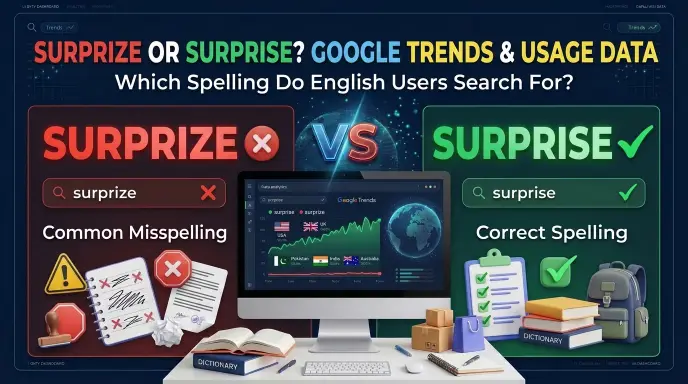
People search for both surprize and surprise because they want to know which spelling is correct. However, the two forms do not have the same status in modern English.
Surprise is the standard spelling. It appears in books, newspapers, websites, school lessons, and everyday communication.
Surprize is an outdated spelling. It may appear in old books, historical documents, or occasional spelling mistakes.
Country-Based Usage
| Country | Standard Spelling | Usage |
| United States | Surprise | Modern standard English |
| United Kingdom | Surprise | Modern standard English |
| Canada | Surprise | Modern standard English |
| Australia | Surprise | Modern standard English |
| Pakistan | Surprise | Standard English writing |
| India | Surprise | Standard English writing |
What Does Google Trends Show?
Google Trends uses a relative popularity score from 0 to 100. It does not show the exact number of searches.
To compare these words fairly, search for both terms in Google Trends using the same time range and region.
You can check:
- Worldwide interest: Compare searches from different countries.
- Country-based interest: See where each spelling receives attention.
- Search patterns: Check whether interest changes over time.
- Related searches: Explore questions people ask about the word.
Important: Without a live Google Trends comparison, exact popularity scores and country rankings should not be claimed. The clear spelling advice remains the same: use surprise in modern English.
Surprize vs Surprise :Spelling Comparison Table
This table gives you a quick way to understand the difference.
| Feature | Surprize | Surprise |
| Spelling status | Outdated | Correct |
| Modern usage | Rare | Common |
| Dictionary standard | Historical variant | Standard spelling |
| British English | Not standard | Correct |
| American English | Not standard | Correct |
| Formal writing | Avoid | Use |
| Everyday writing | Avoid | Use |
The final answer is simple: Surprise is correct. Surprize is an outdated spelling.
Frequently Asked Questions
1. Is it surprize or surprise?
Surprise is the correct spelling in modern English. Surprize is an outdated spelling and should be avoided.
2. Why do people spell surprise as surprize?
Some people use surprize because it looks similar to other English words ending in -ize. It was also used as an older spelling.
3. Is surprize ever correct?
It is an old spelling found in some historical texts. However, it is not accepted as standard modern English.
4. Do British people spell it surprise or surprize?
British English uses surprise. The spelling surprize is not the standard British form.
5. Do Americans use surprize or surprise?
Americans also use surprise. Both British and American English follow the same spelling.
6. What is the plural of surprise?
The plural form is surprises.
Example: Life is full of unexpected surprises.
7. What is the difference between surprise and surprised?
Surprise is a noun or verb. Surprised describes how someone feels after something unexpected happens.
Examples:
- Surprise: The party was a surprise.
- Surprised: I was surprised by the news.
Conclusion
Choosing between surprize or surprise is easy once you know the correct spelling. Surprise is the standard form used in modern English. The spelling surprize is an outdated variant that may appear in older books and historical texts.
Both British and American English use surprise. The same spelling is also common in Canada, Australia, Pakistan, and India. You do not need a different version for different English-speaking audiences.
Remember that surprise can work as both a noun and a verb. You can also use related forms like surprised, surprising, and surprisingly. Each form has a different role in a sentence.
If you are writing an email, school essay, website article, or social media post, always choose surprise. Avoid using surprize in modern writing. A simple way to remember it is to focus on the -ise ending.
The final rule is simple: Surprise is correct, and surprize is outdated. Use the correct spelling to make your writing clear, natural, and professional.
Discover More Articles!
Steem or Steam: Which Spelling Is Correct?(2026)
Prepair or Prepare: Which Is Correct? Meaning and Examples
Unphased or Unfazed: Which Spelling Is Correct?(2026)

I’m Michaelswal, an English grammar enthusiast passionate about helping people improve their writing and communication skills. I share simple, clear, and practical grammar tips to make learning English easier and more enjoyable.

2 thoughts on “Surprise or Surprize: Correct Spelling Explained(2026)”